VIET NAM ANNOUNCED THE INTERNATIONAL FINANCIAL CENTRE FRAMEWORK — WHY THIS IS A STRUCTURAL SIGNAL
12.22.2025 | IDGX
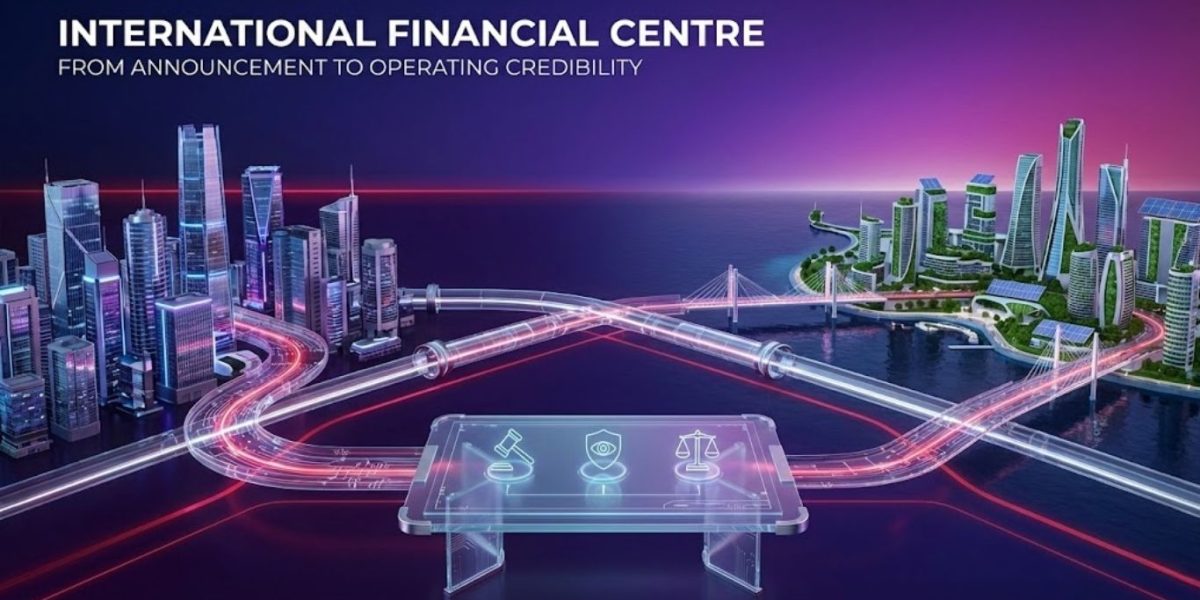
In December 2025, Viet Nam moved from aspiration to operating design: a National Assembly resolution to establish International Financial Centres in Ho Chi Minh City and Da Nang—followed by a Government decree that begins translating intent into an implementation stack.
What matters for long-horizon capital is not the headline—it is the institution-building logic underneath: governance clarity, supervision pathways, and a dispute-resolution architecture that improves predictability and investor confidence.
This is why the announcement resonates beyond finance. It reinforces a broader principle that also applies to the digital economy: structure before scale, trust before acceleration, and capability before complexity.
What was announced — and what is actually new
At the core, the National Assembly passed Resolution No. 222/2025 to establish Viet Nam’s first International Financial Centres in Ho Chi Minh City and Da Nang, effective 1 September 2025. This is the legal starting line that authorises an institutional build-out, not isolated initiatives.

The second layer is sequencing: a National Assembly resolution sets the mandate, and the Government follows with implementing instruments—most notably Decree No. 323/2025 dated 18 December 2025, which begins codifying governance, operating mechanics, and dispute-resolution features for the Centres.
In practical terms, what is “new” is not the idea of a financial centre—Viet Nam has discussed it for years. What is new is the shift from discussion into a formal operating perimeter: defined governance bodies, clearer accountability, and a pathway to enforceability that long-horizon investors look for.
What was actually put in place: the operating stack
An enduring International Financial Centre is not a branding exercise. It is an operating stack: (1) governance and coordination, (2) supervision and compliance pathways, (3) dispute resolution and enforcement mechanisms, and (4) talent and market infrastructure that keeps the system credible over time.

In Viet Nam’s case, the implementing layer includes governance arrangements such as an Executive Council (established by the Prime Minister’s Decision No. 2755/QD-TTg) and associated operating rules described in Decree No. 323/2025. This matters because it turns policy intent into accountable coordination.
The dispute-resolution dimension is also being formalised. Government-facing summaries point to specialised arrangements, including arbitration and pathways for dispute handling—exactly the institutional plumbing that improves predictability and investability for complex, cross-border capital.
Global playbook: what enduring International Financial Centres built first
Global experience is remarkably consistent: enduring financial centres build trust infrastructure before they chase scale. Two instructive examples are the Dubai International Financial Centre and the Abu Dhabi Global Market—both anchored by independent courts, internationally recognisable legal frameworks, and dispute-resolution capabilities designed to make outcomes enforceable and predictable.

Abu Dhabi Global Market publicly frames its foundation around English Common Law, a digitally native court system, and judges drawn from leading common law jurisdictions—explicitly linking legal certainty to the requirements of a well-regulated international financial centre.
Dubai International Financial Centre Courts similarly emphasise an independent English-language common law jurisdiction designed to increase confidence in the legal framework for international business—demonstrating that legal architecture is not a support function; it is the product that markets buy first.
A third reference point—useful for emerging markets—is the Astana International Financial Centre, which built an independent court and international arbitration capability early as part of its credibility strategy for foreign investment. The recurring pattern is clear: governance + dispute resolution + enforceability is the first compounder.
Why this matters to long-horizon capital: predictability compounds
Long-horizon capital does not price only growth; it prices governance quality. When operating rules, supervision pathways, and dispute resolution become clearer, the market’s risk premium can compress—because investors can underwrite outcomes with more confidence.

This is the institution-building logic behind the International Financial Centre push: predictability lowers friction, friction lowers cost of capital, and lower cost of capital improves the feasibility of long-duration projects—especially in infrastructure, technology, and real-economy transformation.
For a venture investor, this is not abstract. It changes the addressable market for startups that sell into regulated enterprises, for infrastructure providers that require enforceable contracts, and for platforms that rely on trust-sensitive flows such as payments, compliance tooling, or asset digitisation.
The bridge to the digital economy: structure before scale
The International Financial Centre framework also strengthens the digital-economy thesis: the hardest part is not innovation—it is institutionalisation. Digital markets scale sustainably only when trust and governance are engineered into the operating system.

This is why the three priorities discussed at IDGX Year End Party remain central—not as themes for a single year, but as structural rails for what comes next: institutional-grade custody as the trust anchor, real-world asset tokenization as real-economy traction, and education for Blockchain and artificial intelligence as market capacity.
In other words: if the International Financial Centre framework is about making long-horizon markets more investable, then custody, tokenization, and talent are complementary building blocks that make the digital economy more governable, more auditable, and ultimately more scalable with integrity.
Value across market participants: who benefits, and what to prepare
For policy makers and regulators, the operating stack is a chance to institutionalise governance patterns that reduce systemic risk. The preparation is to prioritise rule clarity, supervision workflows, and dispute-resolution readiness—because credibility compounds faster than incentives.
For banks, securities firms, and financial institutions, predictability is a commercial unlock: it enables product design, compliance planning, and partnership formation. The preparation is governance maturity—risk management, audit discipline, and operational controls that match international counterparties.
For enterprises and corporate treasuries, the signal is about operating certainty. If governance and dispute-resolution pathways strengthen, long-duration decisions—cross-border expansion, supply chain finance, asset digitisation—become easier to underwrite. The preparation is internal readiness: policy, procurement standards, and trusted infrastructure partners.
For startups and technology builders, the opportunity is not hype; it is a more legible buyer. Clearer governance produces clearer procurement and compliance requirements, which reduces sales friction. The preparation is to build for trust: security engineering, compliance-by-design, and enterprise-grade integration.
For investors and high-net-worth individuals, the operating stack is a signal about market quality. Better rule clarity and dispute-resolution options improve confidence to take longer-dated positions. The preparation is disciplined allocation—understanding governance risk, counterparty risk, and the difference between short-cycle speculation and long-horizon compounding.
For universities, training providers, and the talent ecosystem, this is a demand forecast. When governance tightens, the market pays for people who can operate secure systems, audit processes, and build compliant infrastructure. The preparation is to align curricula with real operating needs—not only theory, but market-grade capability.
Conclusion: a structural signal, not a cycle
Viet Nam’s International Financial Centre framework is best read as a structural signal: a move toward operating clarity, enforceable governance, and confidence-building institutions. That direction aligns with the long-horizon thesis discussed at IDGX Year End Party: trust anchors, real-economy traction, and talent capacity are what make digital markets scale responsibly.
The opportunity now is execution: turning institutional design into repeatable practice. If done well, predictability will compound—and so will Viet Nam’s investability in the decades ahead.
Published by IDGX — Institutional insights on Viet Nam’s government policy signals shaping the next phase of market development.