
Education for Blockchain and Artificial Intelligence: Building the Human Foundation for Vietnam’s Next Phase of Digital Economy
12.09.2025 | IDGX
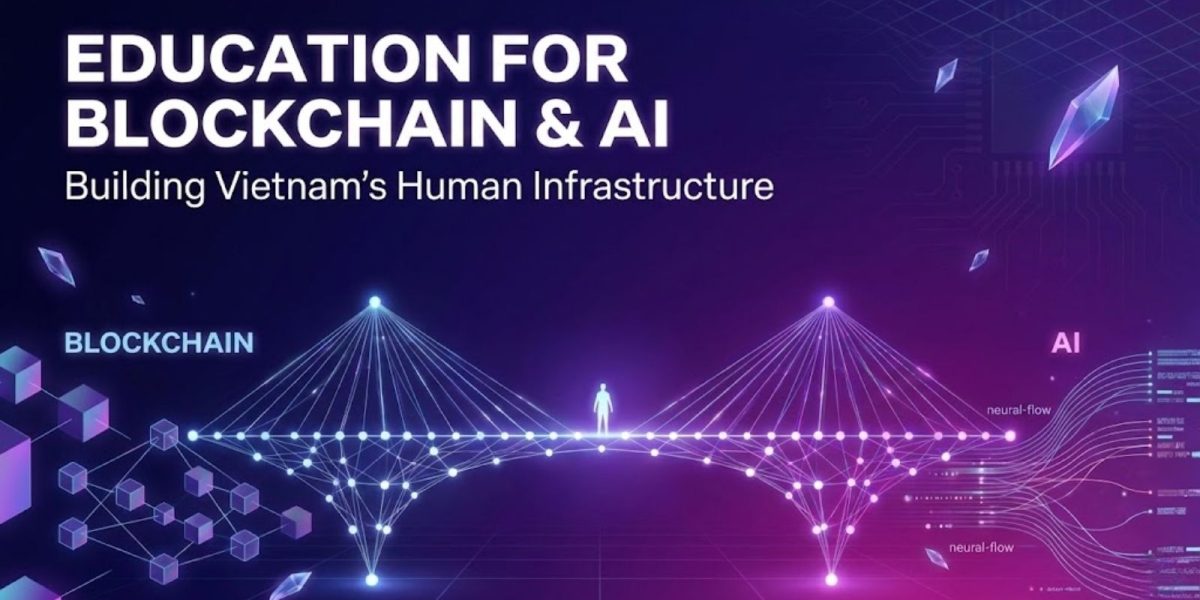
As the digital economy evolves, new technologies are no longer judged by novelty, but by how effectively they integrate into the operating structure of markets—where assets, data, and economic decisions are increasingly embedded in digital systems.
As foundational infrastructure takes shape and new mechanisms move closer to real-world application, a defining question emerges: who will operate, govern, and scale these systems over the long term? The answer lies not in any single technology, but in human capability—the ability to understand, manage, and take responsibility for increasingly complex structures.
In this context, education for Blockchain and artificial intelligence should not be viewed as technical training, but as a foundational pillar, determining whether Vietnam can build a digital market that is orderly, resilient, and capable of sustainable growth in the future.
Education for Blockchain and Artificial Intelligence is not skill training, but market capacity building
Technology education has long been framed as tool-based skill training. Yet as Blockchain and artificial intelligence become embedded in assets, data, and capital flows, this approach reveals its limits. Markets are not constrained by a lack of engineers, but by a shortage of professionals who understand the legal, financial, and governance consequences of technical decisions. In digital asset custody models, real-world asset tokenization, or automated decision workflows, each technical choice can generate system-wide implications. These implications extend beyond performance into legal responsibility, risk governance, and market trust. Education must therefore be understood as market capacity building, not merely workforce expansion.
Markets mature only when human capability evolves alongside technological infrastructure. Education for Blockchain and artificial intelligence is the mechanism that moves markets from experimentation to disciplined operation—where innovation scales within controllable boundaries.
Vietnam’s context: a talent gap in a maturing market
Vietnam benefits from a young, dynamic technology workforce. However, as the digital asset market moves into organization and institutionalization, a clear gap emerges: a shortage of talent capable of connecting technology, law, and finance within one operational logic.
Many organizations struggle not because they lack technical solutions, but because they lack risk assessment capability, operational structure design, and accountability frameworks. As systems tied to assets and data scale, the critical questions are not only “can it be built,” but “who is accountable,” “how is it audited,” “how are incidents handled,” and “how are operating standards measured.”
This gap is therefore not merely a labor supply issue, but a question of market capability quality. If addressed deliberately, Vietnam can do more than close the gap—it can build an advantage: a workforce able to operate digital markets to high standards, aligned with long-term needs across enterprises, financial institutions, and the public sector.
Global references: how Japan and Hong Kong build human infrastructure
Japan approaches education for Blockchain and artificial intelligence through professional standards tightly linked to enterprise needs, focusing on deployment across finance, manufacturing, and governance. The objective is not mass training, but the formation of individuals who can operate systems within clear accountability, where discipline and standards matter as much as innovation speed.
Hong Kong develops education at the intersection of technology, finance, and regulation, emphasizing operational capability under compliance conditions. Many programs aim to produce professionals who can navigate engineering, governance, risk, and policy—people who can “translate” market requirements into safe implementation structures.
The shared strength of both models is not messaging or course volume, but the treatment of education as market infrastructure. People are trained not only to build technology, but to keep markets stable as technology scales.
Education × digital asset custody × real-world asset tokenization × artificial intelligence: a human-centered ecosystem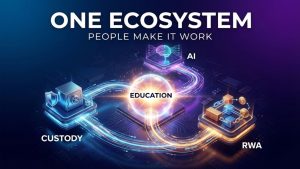
As markets become more structured, digital asset custody, real-world asset tokenization, and artificial intelligence adoption no longer operate as separate themes. They begin to interact through chains of dependency, forming an architecture where any weakness can propagate into systemic risk. This makes the human layer decisive—not as a supporting resource, but as the coordinating center of accountability.
Digital asset custody introduces strict requirements in risk governance: segregation of duties, approval workflows, operating standards, incident response, and audit readiness. These requirements cannot be “purchased” through technology alone. They depend on people who understand operational risk, legal responsibility, and control standards in a digital asset environment.
Real-world asset tokenization expands complexity in another direction: how real assets can be digitized in ways that are data-grounded, verifiable, and enforceable. Engineering is only one component. The rest requires understanding data integrity, business processes, valuation logic, and the legal structure of ownership and claims. Tokenization fails when teams focus on “code” while ignoring the rights-and-obligations architecture of the asset.
Artificial intelligence further increases complexity. When artificial intelligence is used for risk classification, decision optimization, or operational automation, the critical questions are: how transparent are outcomes, who is accountable for errors, and can controls be audited. Powerful artificial intelligence without explainable accountability can create risks greater than the absence of technology.
Education for Blockchain and artificial intelligence therefore does not merely produce “talent”; it produces ecosystem integration capability. It develops people who understand the dependency chain across custody, tokenization, and automation; people who can design disciplined operating models; and people who can run systems under changing market conditions. When human capability fails to keep pace with infrastructure, markets do not advance—they amplify risk.
This is why mature markets invest in human infrastructure before scaling. A human-centered ecosystem does not slow innovation; it makes innovation scalable, governable, and sustainable.
Value across market participants: what each group must prepare to move with the market
For enterprises, education for Blockchain and artificial intelligence is the condition that prevents innovation from becoming risk. Enterprises can purchase technology, hire consultants, or run pilots, but only teams that understand data, process, and governance can integrate technology sustainably. The most important preparation is internal capability: professionals who understand operations, risk, and can align engineering and regulation within a single decision.
For financial institutions and intermediaries, education is the foundation for participation without eroding compliance discipline. These institutions need people who can evaluate custody models, understand real-world asset tokenization structures, and design risk governance aligned with operating standards. Preparation here is not only policy—it is the ability to execute policy in reality, where small deviations can become reputational risk.
For venture capital funds and long-term investors, talent quality is the strongest signal of project durability. Technology can be copied; operating capability and governance are harder to replicate. Preparation for this group is raising diligence standards: not only asking “what does the product do,” but “who operates it,” “how accountability is enforced,” “how deeply the team understands risk,” and “whether the system can scale under compliance conditions.”
For high-net-worth individuals, education distinguishes structured innovation from cycle-driven speculation. As markets mature, opportunity comes with conditions: more transparency, more discipline, and higher literacy requirements. Preparation is not chasing products, but understanding risk fundamentals, rights protection mechanisms, and the ability to evaluate technology claims through market logic.
For regulators and the public sector, education enables policy grounded in operational reality. When technology moves fast, gaps between policy and practice create risk. Effective preparation requires analytical capability: understanding operating models, risk mechanics, and identifying oversight points that work in practice rather than formal control. This is how markets are protected without suppressing innovation.
Finally, for advanced technologists, education unlocks a new career pathway: not only building products, but building market operating structures. The winners in the next phase will be those who combine engineering with data, process, risk, and accountability. Preparation means shifting from “skills” to “system capability,” because as markets mature, advantage belongs to those who see the whole.
Education as market governance capacity: from individual literacy to systemic resilience
As Blockchain and artificial intelligence become economic infrastructure, education evolves beyond workforce development into an internal governance capability of the market. Markets with strong educational foundations can self-correct: detecting risk early, challenging flawed models, and raising operating standards before incidents occur.
This governance capacity does not come from one authority or a small group. It emerges from the ecosystem’s baseline literacy. When enterprises understand risk correctly, when financial institutions operate to standards, when investors conduct deep diligence, when high-net-worth individuals evaluate structure, and when technologists build with accountability, markets develop natural defenses against shocks.
By contrast, markets that neglect education may grow rapidly in the short term while accumulating long-term risk. Small design flaws in access control, data handling, or artificial intelligence oversight may not cause immediate harm. But as scale increases, those flaws become breaking points—triggering loss of trust and high remediation costs.
Investment in education for Blockchain and artificial intelligence is therefore an investment in systemic resilience. It enables growth with discipline, innovation with accountability, and new structures deployed within controllable limits. Markets are not stable because activity is low; they are stable because they possess the capability to understand, operate, and correct before risk becomes crisis.
Over the long term, nations that master education for Blockchain and artificial intelligence control the pace and quality of digital economic development. This is not a race for engineering headcount or course volume, but a race for market organization capability: operating digital assets safely, scaling enforceable real-world asset tokenization, and deploying accountable artificial intelligence.
National competitive advantage is not created by chasing technology, but by converting technology into market capability. When the talent baseline is strong, enterprises implement faster with less risk; financial institutions participate deeper with more discipline; investors allocate long-term capital with greater confidence; and the public sector designs policy closer to operational reality because it understands how systems run.
For Vietnam, human infrastructure is the opportunity to move beyond being a technical labor supplier into becoming a structural participant. With professionals who understand both technology and governance, Vietnam can do more than adopt external models—it can design structures suited to domestic market realities. This is how Vietnam integrates into the global digital economy with agency rather than dependency.
This is why education for Blockchain and artificial intelligence should never be treated as a “soft” topic. It is hard infrastructure for the future: the factor that determines whether pillars such as digital asset custody and real-world asset tokenization can scale sustainably, and whether innovation compounds into long-term advantage rather than repeating in cycles.
Published by IDGX — Institutional insights on education, governance capacity, and the long-term foundations of Vietnam’s digital economy.